Showing posts with label state budget. Show all posts
FY 2023 State Budget 
Deputy Republican Leader Tom Demmer and Republican Floor Leader Mark Batinick offered the following comments on Governor Pritzker’s federally-funded budget that ignores the financial pressures in Illinois’ immediate future.

Deputy Republican Leader Tom Demmer:
“A year and a half ago, Gov. Pritzker was threatening Illinois voters with draconian cuts or across-the-board tax increases unless they approved his $3.4 billion tax increase amendment. But voters said no.
Comptroller Leslie Geissler Munger announced Wednesday that if the state continues its current rate of spending without a balanced budget, Illinois' backlog of unpaid bills to schools, hospitals, businesses, social services and other vendors will exceed $8.5 billion by the end of the calendar year.

Munger said court orders, consent decrees, and statutory continuing appropriations (including debt service, pension payments, tax refunds and lawmaker salaries) are funding 90 percent of the state's bills even though the General Assembly and Governor have been deadlocked on a budget since July 1.  The problem is, the spending is based on FY 15 levels while revenue is based on FY 16 levels, which is running considerably lower due to the sunset of the temporary tax increase in January.
Illinoisans cannot be clearer; they do not want the state to raise taxes, any taxes, until and unless reforms are in place. Reforms that will ensure the spend-and-borrow policies of the past don’t continue. Reforms that curtail rampant abuse of state allocated grants. Reforms that encourage job growth.

Taxpayers don’t trust politicians with their money and they need proof Springfield has really changed before they give the okay to increase revenue.
Last year, the Democrats who run the Illinois House and Senate passed a phony budget. It kept everybody happy by promising lots of spending. But it didn't raise nearly enough money to cover all that spending.

The governor signed it. That was Pat Quinn.

The voters saw right through it. They elected a new governor. That's Bruce Rauner.

And this year, having learned their lesson, the Democrats who run the Illinois House and Senate are ... wait. What? They're going to do it all over again?

Really?

They're apparently preparing to pass another phony budget, one that promises to spend much more money than the state has.

And the governor? Oh, that's right. There was an election.

Gov. Bruce Rauner spent his first months in office fixing the phony budget his predecessor signed. Read the Chicago Tribune editorial in its entirety.
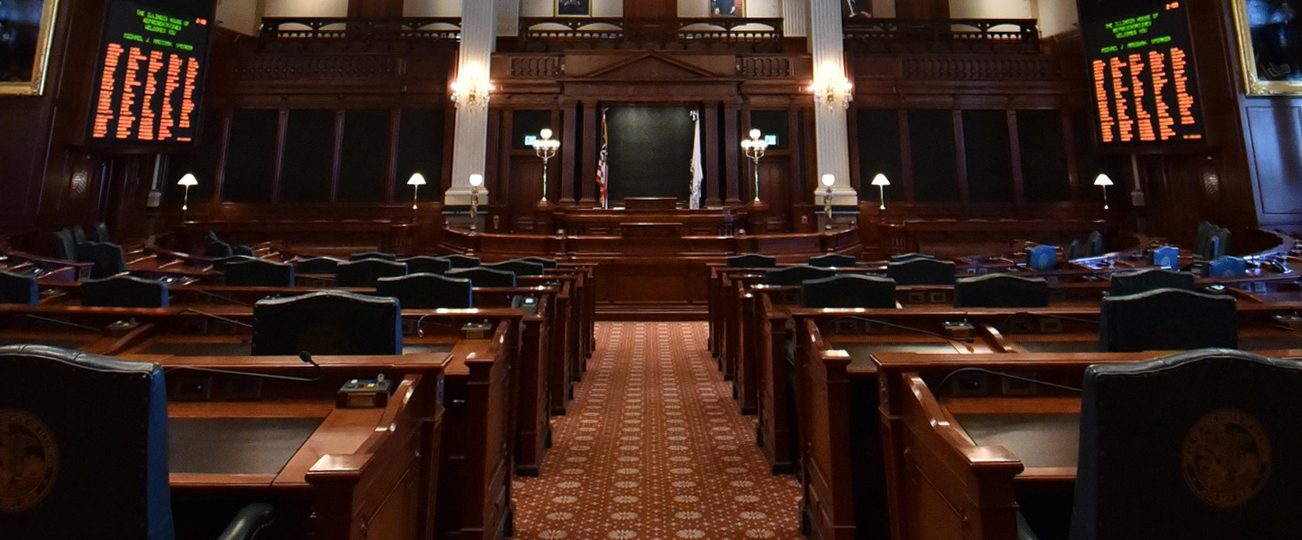
An all too often told story played out again today in the Illinios House of Representatives; the story of a broken, backwards budgeting process intended to divide, not unite.

The process began with the Governor’s introduced budget which is meant to be a starting point for negotiations through which changes are made, with a final budget arriving back on the Governor’s desk for either approval or rejection.

The budget process is designed to ensure all priorities are considered and more important that all decisions are made in an open and transparent manner.
The Illinois House of Representatives passed Governor Rauner's FY15 Budget Fix today. The legislation now heads to the Senate and should be heard later this week. Here's what some of our members had to say:

House Republican Leader 
Jim Durkin
"...Governor Rauner inherited a $1.6 billion budget deficit the day he took office...I am pleased the Illinois House of Representatives began the hard work of straightening out our dire state finances."
Chicago – NRI
Federal subpoena against Quinn agency responsible for NRI.  A federal prosecutor based in Chicago has issued a subpoena against the Illinois Criminal Justice Information Authority, a State panel that monitors funding for crime-fighting activities statewide.  The subpoena was dated August 27 and was made public on Tuesday, September 18.  The Authority was the successor-in-interest to the 2010 Neighborhood Recovery Initiative (NRI), a $54.5-million program funded by Democrats in the Illinois General Assembly that targeted State taxpayer general funds toward social-work initiatives.
Leader Jim Durkin calls on the Governor to explain spending
The Illinois Senate and House Republican Leaders today – in concert with members of the Legislative Audit Commission – called on Governor Quinn and his Administration to lift the curtain of secrecy and come clean on new spending for a rebranded version of his failed Neighborhood Recovery Initiative.

“We’ve seen a disturbing pattern of a lack of transparency from Governor Quinn and his Administration,” Senate Republican Leader Christine Radogno said. “Every week we see new reports about the mismanagement of the NRI program. Every week, Governor Quinn spins that he’s fixed the problems. It’s the same claim he made about the patronage scheme at the Department of Transportation and we all know now that just wasn’t true.
Budget - Debt Rating
Bloomberg News analysis shows Illinois’ 10-year bonds trading at below BBB level. The actual level of safety and security perceived by global debt markets is set by the bond marketplace, with guidance from the three credit rating services (Moody’s, Standard & Poor’s, and Fitch Ratings). However, after the 2008 financial panic, many investors have become skeptical of credit rating services. A Bloomberg News analysis, published on Thursday, August 7, indicates that this skepticism may be weighing down the prices of Illinois bonds.
Sign up to get Week in Review emailed to you.
Capital Road Projects 
$1.1 billion for roads and bridges. HB 3794 and SB 3224, a two-bill package, sets aside $1.1 billion for road and bridge repairs in Illinois. Of this sum, $100 million will be distributed to local governments by pre-existing formula, and $1.0 billion will be spent through the Illinois Department of Transportation (IDOT) on urgent road and bridge projects identified in the Department’s existing multi-year plan.

Proponents of these bills point to inadequate funds from motor fuel taxes. The legacy of increasing numbers of Illinoisans buying gas-sipping smaller vehicles, and repeated raids on the Road Fund to meet other spending programs of the State, have made it impossible in the eyes of transportation experts for IDOT to fully fund its commitments to construct and reconstruct the road and bridge projects that its long-term plan had already committed to accomplish. The $1 billion committed in this two-bill package is meant to provide resources to maintain the usable status of Illinois roads and highways and to keep these road safety and usability commitments.
Get Week-in-Review delivered to 
your email inbox every week
Final Days of 2014 Spring Session
As third week of May ends, only six session days remain for vital work. Left undetermined as of Friday, May 23 were key decisions affecting the future of all Illinoisans, including the FY15 State budget.

The key twelve-month spending plan will govern State spending and operations starting in only one month, July 1, 2014. A $3 billion gap between expected State tax revenues and Democrat-led spending requests will create significant challenges for lawmakers.

Substantive, non-budget issues will also require action, and positions and legislative language could change over this period from moment to moment. Stay tuned to The Caucus Blog for continuously updated information on these key questions.


Yet another study has placed Illinois in the worst fiscal condition in the nation.  Research conducted by Dr. Sara Arnett of the Mercatus Center at George Mason University placed Illinois 50th in the report, State Fiscal Condition: Ranking the 50 States. The report pointed to poor decisions, both financial and economic as the leading indicator of poor performance.
Budget – Medicaid
Big Medicaid changes could save money for Illinois taxpayers, but must be closely watched.  The State of Illinois is pursuing a comprehensive restructuring of the way services are delivered to the 2.8 million enrollees who receive medical coverage through the Illinois Medicaid program. This restructuring, which would be directed through the federal ‘1115 Waiver’ process, would allow the use of innovative service delivery models not currently standard under federal Medicaid guidelines. On Wednesday, the House Human Services and Appropriations – Human Services Committees held a joint hearing, the second in a series of such meetings, to receive testimony from administration officials and stake holders regarding the proposed waiver.
One of Illinois Comptroller Judy Baar Topinka’s primary responsibilities is to pay the state’s bills. Given that duty, she has made it a priority to reach out to nonprofit agency vendors across the state to ensure that they do not slash services or shut their doors altogether due to state payment delays.

Topinka knows that the nonprofit sector provides essential services to folks who need them the most, including seniors, children and those with disabilities.

As the state’s bill backlog stacks up, Topinka’s staff prioritizes what must be paid statutorily and under specific time constraints.  She has instructed staff to make nonprofit payments one of the top priorities.

Read more about the Comptroller's Program
Illinois has Heart flyer
Illinois Nonprofit Advisory Council
Pensions – General Assembly
General Assembly to meet in session on Tuesday, December 3.  The session is expected to deal with the ongoing Illinois pension crisis.  Many State lawmakers and statewide elected officials have called for action to deal with at least $97 billion in unfunded liabilities reported by four major pension systems managed by boards of directors appointed by the State of Illinois, and partly funded by taxpayers.
Obamacare
House Republicans demand answers after thousands of Illinois residents report losing health insurance.  The implementation day of the federal Affordable Care Act, October 1, 2013, imposed complex and costly new mandates upon private health insurance policies sold, or provided by employers, to Americans citizens and residents.  A large segment of previously profitable health insurance policies have become unprofitable.

In the weeks following the “Obamacare implementation date,” a significant number of Americans have reported to their lawmakers that they have recently received letters from their insurers,
House Republican Leader Jim Durkin
Jim Durkin unanimously elected by Illinois House as Republican Leader.  Durkin’s election, which was an anticipated event after his colleagues unanimously elected him in August 2013 to lead their caucus, took place on Tuesday, October 22.  This was the first day of the Illinois House and Senate veto session, a series of days set aside in the fall to respond to veto messages submitted by the Governor and take action on urgent issues of public interest.  Durkin’s election formalized his status, and renewed the ability of House Republicans to slate members of House committees and participate in the naming of members of their caucus leadership team.

Leader Durkin announced that his highest priority would be to reverse current State laws that discourage job creation and economic growth.  “The biggest social issue of the day is the 9.2 percent unemployment rate,” Durkin told reporters.  Illinois’s jobless rate is currently the 2nd highest of the 50 U.S. states, exceeded only by Nevada.
Budget

·         State budget picture improves.  The September 2013 monthly update on Illinois economic activity published by the Commission on Government Forecasting and Accountability (CGFA), the economic “think tank” maintained by the General Assembly, reports that General Funds revenue receipts for the first quarter of FY14 are tracking ahead of the receipts for the same period in FY13.  For the first three months of FY14, net General Funds receipts total $8.433 billion.  This total is $700 million higher than the FY13 total for the first quarter.  A primary reason for the increase in FY14 revenue receipts is a one-time spike in transfers in August from the Income Tax Refund Fund into the General Fund.  This one time transfer accounts for $397 million of the first quarter revenue growth.

Receipts from both the personal income tax and the corporate income tax have also seen growth compared to FY13.  Revenue from the personal income tax is up $205 million (net of refunds) and receipts from the corporate income tax are up $75 million (net of refunds).  Perhaps the strongest surprise in growth is due to the sales and use tax, which is up $139 million year to date.  Strong continued growth will be necessary to provide sufficient revenue to support the $35.446 billion appropriated in this year’s FY14 spending bills.  More information may be found at http://cgfa.ilga.gov/Home.aspx.