Showing posts with label Medicaid. Show all posts
Governor Rauner – Medicaid Proposal
Gov. Bruce Rauner makes major Medicaid proposal. The proposal to increase the percentage of Medicaid medical cases that move through “managed care” was unveiled on Monday, February 27. The state’s chief executive called for expanding existing Medicaid managed care programs to cover 80% of Illinois’ three million Medicaid patients. This would mark a major increase in managed care from the current percentage of nearly 67%. In Medicaid managed care, private insurance firms serve as “gatekeepers” for treatments, performing a role similar to insurance firms that manage groups of families that receive employment-based health care.
Budget – Medicaid
House Republicans again push to impose limits on the rate of Medicaid growth.  Medicaid patient headcounts and expenditures are shooting up nationwide. This pattern is partly due to the federal Affordable Care Act (“Obamacare”), which encourages the states to expand and enlarge their individual Medicaid programs.  In 2012, 72.2 million American residents – more than one-fifth of the nation’s population – were covered by Medicaid for at least one month.  In their story this week, “Reversing the Medicaid Tidal Wave in Illinois”, The Caucus Blog describes the national numbers.  
Rep. Patti Bellock
Every state is struggling with the explosive growth and cost of its Medicaid program. Illinois, however, found a way to reduce Medicaid spending significantly, freeing up money for other important projects—or better yet, tax cuts.

Medicaid, the government health-insurance program for the poor and disabled, covered 72.2 million people for at least one month in 2012, according to estimates from the Department of Health and Human Services.

But enrollment is growing quickly. The Centers for Medicare and Medicaid Services reports that Medicaid and the Children’s Health Insurance Program (CHIP) enrollment is up by about 8.7 million people—nearly 15%—since the Affordable Care Act’s October 2013 rollout. Total Medicaid spending was about $432 billion in 2012. The federal government provided $250 billion, or a bit more than half, but states paid the rest.

For many states, Medicaid is already their single largest expenditure, and now it is demanding more, forcing state governments to limit or reduce spending in other important areas like education and welfare.

Enter the Illinois solution. In 2013, the state faced a Medicaid budget shortfall of $2.7 billion. Springfield had begun implementing some reforms, such as shifting more Medicaid recipients into private managed-care organizations, but that wasn’t enough.

So Illinois state Rep. Patti Bellock garnered bipartisan support to pass legislation in 2012 that included several Medicaid reforms. One of the most important was a provision to establish the Illinois Medicaid Redetermination Program to “redetermine” if Medicaid enrollees were still eligible to participate.Every state is struggling with the explosive growth and cost of its Medicaid program. Illinois, however, found a way to reduce Medicaid spending significantly, freeing up money for other important projects—or better yet, tax cuts. Read more by Merrill Matthews in the Wall Street Journal.

Healthcare – Medicaid Audit

Audit finds Illinois overdrew federal Medicaid dollars. A U.S. Department of Health and Human Services’ Office of Inspector General report found that Illinois overdrew its actual Medicaid spending by an average of $60 million per quarter during the three years reviewed due to “faulty” and “imprecise” practices. The federal government estimates it may have lost as much as $792,000 in interest from fiscal year 2010 through 2012 because Illinois was delayed two to six months in repaying the money.
The Illinois Medicaid program paid an estimated $12 million for medical services for people listed as deceased in other state records, according to an internal state government memo.

The memo dated Friday, which The Associated Press obtained through a Freedom of Information Act request, says the state auditor compared clients enrolled in the Medicaid database last June with state death records dating back to 1970. Auditors identified overpayments for services to roughly 2,900 people after the date of their deaths.
Senate Democrats blocked legislation during a March 19th Senate Human Services Committee sponsored by State Sen. Dale Righter (R-Mattoon) that would have reversed the Quinn Administration’s actions undermining the key aspect of the state’s bipartisan Medicaid reform law aimed to reduce fraud.

Both Righter and State Rep. Patti Bellock (R-Hinsdale) filed companion legislation in their respective chambers to address the legal issues that have halted implementation of the 2012 Medicaid reforms and allow for the third party review of state Medicaid rolls to continue.
Budget – Medicaid
Big Medicaid changes could save money for Illinois taxpayers, but must be closely watched.  The State of Illinois is pursuing a comprehensive restructuring of the way services are delivered to the 2.8 million enrollees who receive medical coverage through the Illinois Medicaid program. This restructuring, which would be directed through the federal ‘1115 Waiver’ process, would allow the use of innovative service delivery models not currently standard under federal Medicaid guidelines. On Wednesday, the House Human Services and Appropriations – Human Services Committees held a joint hearing, the second in a series of such meetings, to receive testimony from administration officials and stake holders regarding the proposed waiver.
Obamacare
House Republicans demand answers after thousands of Illinois residents report losing health insurance.  The implementation day of the federal Affordable Care Act, October 1, 2013, imposed complex and costly new mandates upon private health insurance policies sold, or provided by employers, to Americans citizens and residents.  A large segment of previously profitable health insurance policies have become unprofitable.

In the weeks following the “Obamacare implementation date,” a significant number of Americans have reported to their lawmakers that they have recently received letters from their insurers,
Rep. Patti Bellock
Rep. Patti Bellock (R-Hinsdale) today took to the House floor to review the success of the Maximus Medicaid review contract, and to ask when legislators might get an answer from Governor Quinn's administration regarding an appeal of an arbitrator's suspension of the contract. In the short time it was active, Maximus' audit of Medicaid eligibility found thousands of ineligible persons claiming Illinois Medicaid benefits. The audit potentially saved millions of taxpayer dollars before it was terminated by the arbitrator. The full video is available here.
 Bellock says Illinois is taking a $6.5 billion risk
with Medicaid expansion.
Obamacare is doing what it was designed to do in Illinois — adding thousands upon thousands of people to the state’s Medicaid rolls.

Gov. Pat Quinn bragged Tuesday about the more than 100,000 people he said have enrolled through the Affordable Care Act. But Quinn left out two very important facts. Almost all of those people were early enrollees last year, and every single one of them enrolled in Medicaid.

 Rep. Patti Bellock is the GOP point person on Medicaid in the Illinois House of Representatives. She has been trying to tell Quinn and his fellow Democrats that Illinois is taking a huge risk by opening Medicaid to that many people. Benjamin Yount has the whole story at Illinois Watchdog.com.
Durkin Takes Reins as New House Republican Leader

·         Representative Jim Durkin (R-Western Springs) takes over as Leader of the House Republican Caucus.  The transition took place on Monday, September 23.  Representative Tom Cross (R-Plainfield), the leader of the House Republicans for ten years (2003-2013), moved on to turn his attention to other opportunities.  While Cross plans to serve out his legislative term, Durkin becomes the leader of the forty-seven House Republican members.

Jim Durkin, a practicing attorney, began his House service in 1995.  He has served repeatedly on the House’s Judiciary Committees, specializing in issues of criminal law and civil misconduct.  He was a leader in the bipartisan investigatory committee that gathered evidence and made a recommendation that led to the impeachment and removal from office of former Governor Rod Blagojevich in 2008-2009.  In 2012-2013, Durkin led the General Assembly’s efforts to investigate and help regain financial stability for the troubled “College Illinois” savings program.    
Budget – Medicaid Reform

·         Representative Patty Bellock questions Quinn administration’s compliance with Medicaid reform.  In a Chicago budget hearing on Tuesday, September 17 that centered on Medicaid and health care issues, members of the Illinois House questioned the Department of Healthcare and Family Services (DHFS) about the Department’s implementation of Medicaid reforms.  The General Assembly, bound by its constitutional duty to generate a balanced budget, appropriated money to DHFS for Medicaid that assumed that these reforms, which have been enacted into law, would be carried out. 

One key reform, looked at closely by the Illinois House this week, is the scrutiny of existing Medicaid patients to see how many of them are legally ineligible for Medicaid.  Existing law assumes that this redetermination will be carried out under contract by the private sector, and DHFS has contracted with Maximus, a service provider with experience at performing database scrutinies and redeterminations of this type. 

Chicago
City of Chicago deficit will balloon to $1 billion without pension reform.  The Chicago Tribune reported this week that Mayor Rahm Emanuel will not raise sales or property taxes to close a $338.7 million budget deficit for next year. By 2015, the shortfall will balloon to $1 billion without pension reform.

In 2015, Chicago is required by state law to make a $600 million contribution to its police and fire pension funds that currently only have assets to cover just 30.5 and 25 percent of their liabilities. Chicago leaders have suggested that the Illinois General Assembly should relieve Chicago of the pension payment “ramp up” requirement and allow the City to extend payments over a longer period of time.

Chicago’s deficit will rise to $994.7 million in 2015 and $1.15 billion in 2016 without strong pension reforms and possibly new revenues.
Budget 
General Assembly enacts $35,446,000,000 State budget. The spending plan for fiscal year 2014, which will begin on July 1, 2013, increases the drain of the State’s checkbook by more than $360 million above levels anticipated at the beginning of the 2013 spring session.

Swelling expenditures for medical care, including medical care for Medicaid public aid recipients and State employees/retirees, are pointed to as the reason for the out-of-control expenditure level. While the General Assembly took legal steps in spring 2012 to reduce future Medicaid expenditures, the Governor’s administration did not fully implement these steps in practice over the following 12 months that made up FY13. Meanwhile new, unanticipated caregiving expenses, reflecting more expensive diagnostic practices and the addition of newly invented and approved pharmaceuticals and medical treatments, continue to be presented by patients and their caregivers to the Medicaid system and the State.

The budget, which was contained in a package of seven bills numbered HB 206, HB 208, HB 213, HB 214, HB 215, SB 2555, and SB 2556, plus the budget implementation bill SB 1329, was approved by votes of the majority party in the House and Senate in the week ended Friday, May 31. Republicans were not able to support these budget bills. The bills were sent to the Governor for his approval.

Concealed Carry 
General Assembly, in final day of 2013 session, enacts concealed-carry bill. The concealed-carry language was approved by both houses as HB 183 on Friday, May 31. The House vote was 89-28-0. 

HB 183 will make Illinois a “shall issue” state, with a legal presumption in favor of granting a $150, five-year license to carry a concealed firearm to every valid applicant who requests one. The gun-control ordinances of the city of Chicago and other gun control home rule units are partly overridden by this measure. However, this bill, if signed into law, will allow these municipalities to continue to try to ban so-called “assault weapons.”
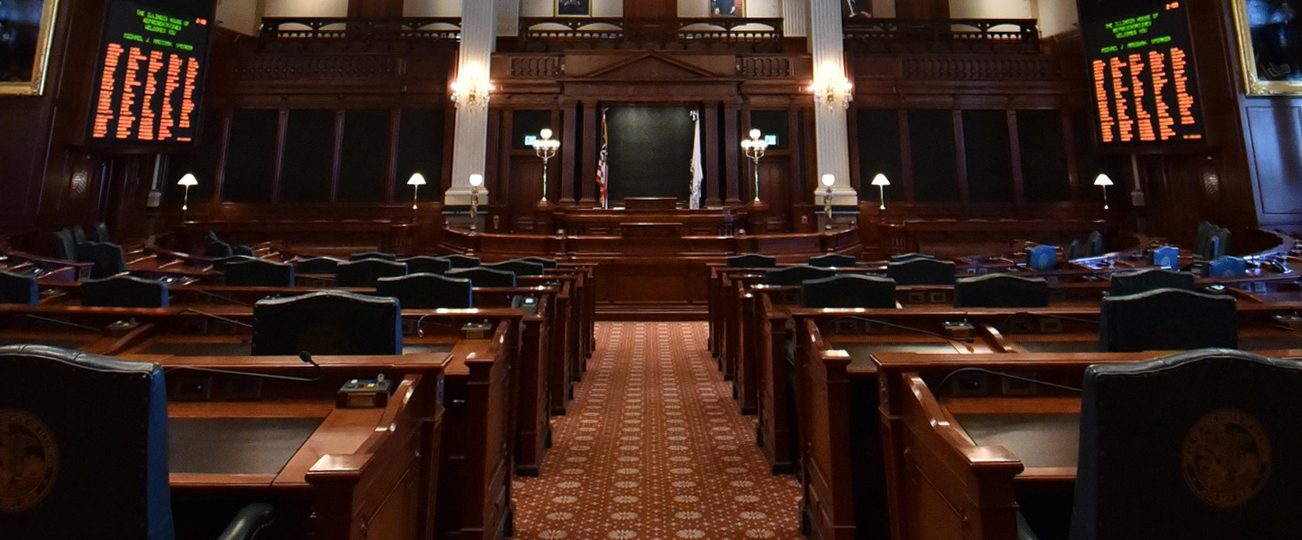
On May 27, 2013 the House debated Medicaid Expansion. All Republicans voted against the measure. Here's what several of our members had to say during that debate:

The courts are allowing us to enroll in the Federal Medicaid Expansion at any time,” said Rep. Patti Bellock. “This is no time to rush into a massive expansion the State and Illinois taxpayers cannot afford. We need to spend more time getting our fiscal house in order to ensure Medicaid is sustained for those it was designed to serve.” 


by House Republican Leader Tom Cross in May 24th Daily Herald.
As a result of legislation passed last year by the Illinois General Assembly, a private company is analyzing Illinois' Medicaid program to make sure it is running efficiently and that those who are receiving benefits are legally eligible to receive these services.
Maximus, the company hired to review the program, has reviewed 65,995 cases this year and made recommendations. Of those, the state made final determination on 51,587 cases, which has resulted in a conclusion that 26,871 do not qualify under current state law. The reasons are primarily because these individuals either don't live in Illinois or they don't meet the income guidelines. Read more at the Daily Herald...
For state Rep. Mike Bost, R-Murphysboro, this was the last straw: A food stamp recipient in his district used her Link card to bail herself out of jail.

"We are losing a couple billion dollars in fraud and we know that," Bost says of Illinois' Link program, which provides food and, in some cases cash, to needy families. "I've never been one opposed to providing for the needy. There are true needs. But if it's just for the greed, it doesn't matter if it's this or corporate greed, it's got to stop."

Link card for bail money? What's next? Link cards to gamble at slot machines ? Oh, wait ... read on.

For the full editorial, click here: http://www.chicagotribune.com/news/opinion/editorials/ct-edit-link-20130520,0,6222550.story