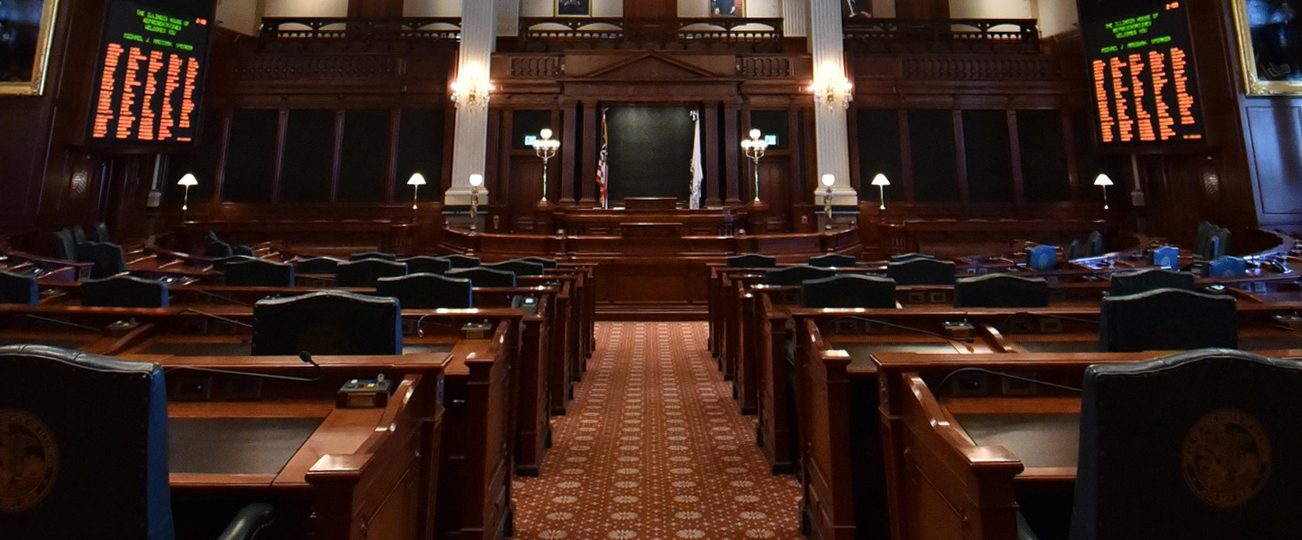
Row 2: Reps Rich Brauer & Raymond Poe at Oak Ridge Cemetery Gate Dedication and with Menard County Fair Queen.
![]() |
| Potawatomi Fashion at the Field Museum in Chicago photo by Victorgrigas |
Gravesite of Chief Big Thunder.
Chief Big Thunder, a legendary Potawatomi statesman, died before Euro-American settlers began arriving in the Belvidere area in the 1830s. After his death and following an ancient custom, Potawatomi tribespeople gave their chief an above-ground burial, clothing him in his best ceremonial garb and sitting him upright inside a six-foot-high stockade. They equipped him with pipes, tobacco, and food for his afterlife journey, and left his remains to decompose in the open air.
Scavengers in the form of tourists later vandalized Big Thunder's burial site. Residents compensated by erecting a memorial near the county courthouse. Read more here.
It costs $21 for a lawmaker to take the train between Chicago and Springfield, or about $65 for them to drive.
But it costs taxpayers $4,060 when lawmakers choose to fly a six-seat executive airplane between the two cities.
Despite the enormous cost difference, the presiding officers of both the Illinois House and Senate are choosing to fly in the taxpayer-funded executive planes.
The practice has been going on for decades, but as the state struggles to pay its bills some are wondering if it is something Illinois can afford.
“Would getting rid of these planes solve the state’s budget problems? No. But it is of enormous symbolic value. The leaders seem unwilling to sacrifice,” said state Rep. Bill Mitchell, R-Forsyth, who has introduced legislation to eliminate most of the state’s fleet of executive aircraft. Scott Reeder tells the story at the Illinois News Network.
Taxes
House Republicans take stand against “progressive” income tax proposal. At the end of the 2013 spring session, the Democrat majority introduced a new State constitutional amendment, HJRCA 33, for discussion. This amendment, if it were approved by both houses and ratified by the voters, would abolish the current flat-rate income tax (the current rate is 5.0 percent on individuals) and replace it with a graduated or “progressive” income tax rate that would rise with the income of the taxpayer. Enactment of a progressive income tax law could open the door to income tax rates much higher than 5.0 percent for many Illinoisans, and with inflation more and more households (including middle-class households) would be subjected to the higher rates. Graduated income tax rates are higher in neighboring states which constitutions allow these rates to be charged. For example, higher-income Iowa individuals must pay a rate of 8.98 percent.
![]() |
| Lynn Martin |
![]() |
It hasn't made a difference. At least, not enough of a difference.
The mess at Metra and a few other related matters have lifted a grand curtain on how Chicago works, providing a peek at the wheels of government and what oils them. And that peek suggests that, in many, many ways, we're still living somewhere around, say, 1957. Still allowing local and state government to be not a place where the public is served, but a place to set up a family business and profit as much as possible for me and mine. Greg Hinz at Crain's has the rest of the story.
![]() |
| Abraham Lincoln, whose Emancipation Proclamation freed more than four million slaves, was an effective politician, profound statesman, and a shrewd diplomat. He also had a keen sense of humor. His stories and anecdotes gave rise to his moniker as the "Great Story Telling President." For the next few weeks we will share some of those stories from the *Project Gutenberg's Lincoln's Yarns and Stories, by Alexander K. McClure. We hope you enjoy them as much as we do. |
Lincoln never told a better story than this:
A country meeting-house, that was used once a month, was quite a distance from any other house.
The preacher, an old-line Baptist, was dressed in coarse linen pantaloons, and shirt of the same material. The pants, manufactured after the old fashion, with baggy legs, and a flap in the front, were made to attach to his frame without the aid of suspenders.
A single button held his shirt in position, and that was at the collar. He rose up in the pulpit, and with a loud voice announced his text thus: "I am the Christ whom I shall represent to-day."
Subscribe to:
Posts
(
Atom
)