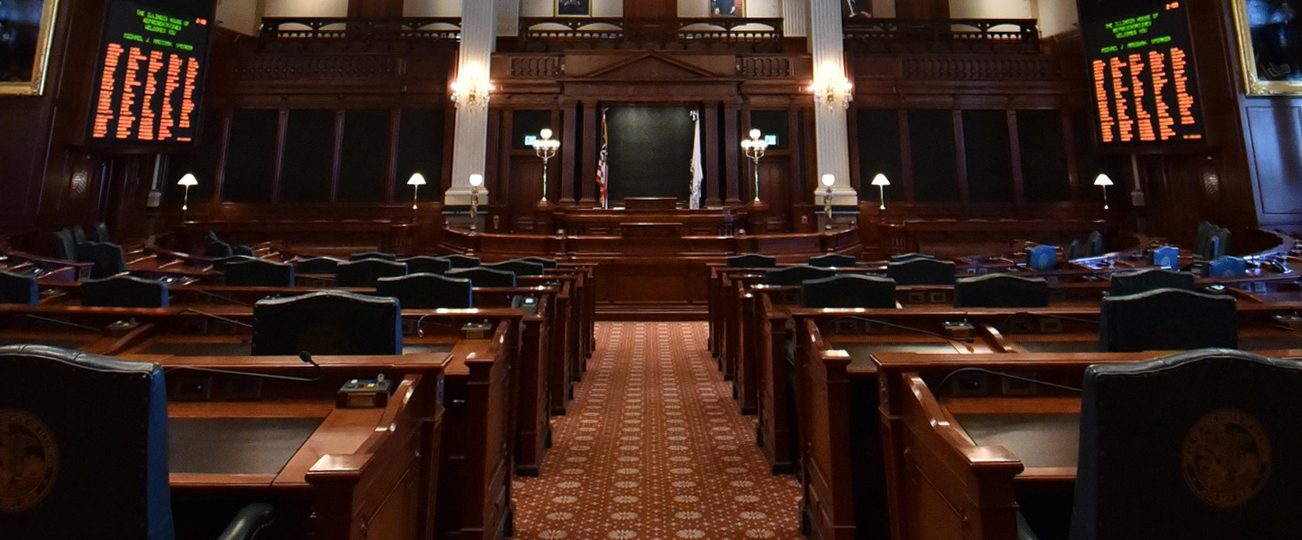
Photo from the Naperville Heritage Collection, Illinois  Digital Archives.
A service of the Illinois State Library & Office of the Illinois Secretary of State.
When the Illinois General Assembly is in session, Representatives and Senators make their way to the Illinois State Capitol building at the corner of 2nd and Monroe in Springfield. But they haven’t always met there. In fact, this building is actually the sixth different structure in Illinois which has served as the state capitol since the first General Assembly met almost 200 years ago.

Illinois’ first capital city was the Mississippi River town of Kaskaskia. It was here in 1778 that George Rogers Clark defeated the British during the Revolutionary War. The town soon became the administrative center for the area, and eventually the territorial capital of Illinois. At statehood in 1818, it was the logical choice for the first state capital. Governor Shadrach Bond took the oath of office as Illinois’ first chief executive in Kaskaskia.
Here are a few of the editorials from Illinois newspapers:

From the Springfield Journal-Register:
New education funding formula will benefit Illinois’ children

Education funding reform has been a long time coming in Illinois, and the state is finally on the cusp of it arriving.

After plenty of political theater — including last-minute amendments, sitting on the bill, a far-overreaching amendatory veto by the governor, missing the first two payments to school districts for the new academic year, and three dramatic votes in the House before it garnered enough “yes” votes to pass — Illinois lawmakers have approved a new way to fund the state’s K-12 schools. Keep reading the editorial.
The bipartisan compromise on the education funding bill that passed in the House of Representatives ensures, for the first time in decades, that all children in Illinois will have access to education that is funded fairly and equitably.

 
Last night the House passed a historic compromise education funding plan that ensures all children in Illinois will have access to a high quality education. Read more about SB 1947.

Here is what some of our members are saying about it.

Rep. Christine Winger
“Today’s agreement is a historic step forward for education funding, one that will help our students have the opportunities they deserve to succeed while also ensuring all school districts are treated fairly.”
BUDGET – EDUCATION FUNDING
Legislative leaders, Governor reach agreement in principle on historic education funding reform. The four caucuses’ legislative leaders negotiated face-to-face this week on a path forward for Illinois’ public school funding formula. An agreement in principle was announced on Thursday, August 24.
BUDGET
House Democrats play games with education funding. Following the Senate’s vote on Sunday to override Governor Rauner’s Amendatory Veto of Senate Bill 1, the Illinois House met in session on Wednesday, ostensibly to act on education funding reform.

Unfortunately, Wednesday’s House session was nothing more than political theatre.

Rather than negotiate a compromise to achieve fair and equitable funding for schools throughout Illinois, Speaker Madigan once again chose to do nothing.

State Reps. Michael McAuliffe, Christine Winger, Peter Breen, Grant Wehrli, and Keith Wheeler today introduced legislation, House Bill 4082, to immediately repeal the one-cent-per-ounce Cook County Sweetened Beverage Tax. The tax, which went into effect on August 2, will result in Cook County consumers having to pay on average 67 percent more for a 2-liter of pop, 43 percent more for a gallon of juice drink or sweetened iced tea, and 29 percent more for a 12-pack.