
.png)
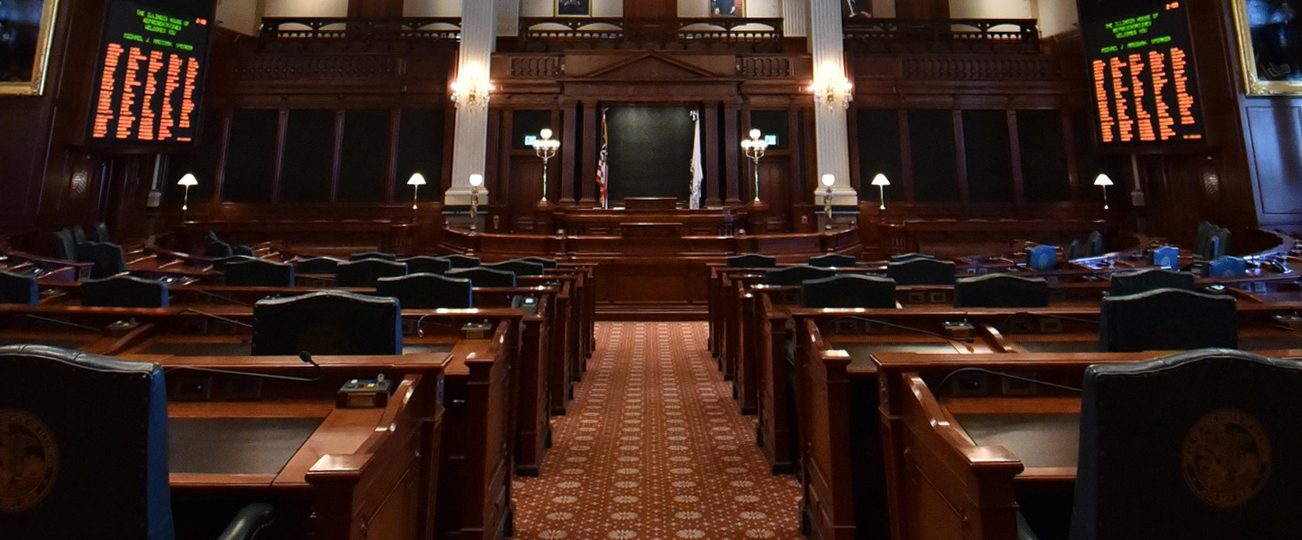
Republicans Will Continue to Expose and Oppose Bad Policy. As lawmakers in the Illinois House prepare to return to legislative session next week, Illinois House Minority Leader Tony McCombie has set expectations as to where her caucus’ priorities will be when the House convenes on January 20th.
At a recent City Club of Chicago event, Speaker of the House Emmanuel “Chris” Welch said the legislature is focused on “bringing down the cost of living,” and suggested that meeting the everyday needs of Illinoisans takes precedence over requests for new high-profile projects like a Bears stadium.
But for Leader McCombie, real fiscal responsibility must be backed up with good public policy–a stark contrast she says her caucus will continue to expose, considering recent budgets based on billions of dollars in tax hikes and gimmicks that Illinois’ Democrats have become accustomed to.
Republican lawmakers have underscored that affordability must also include fiscal restraint and tax relief. Leader McCombie said in a recent interview that she thinks 2026 “would be finally a good time for Democrats to bring Republicans into the room” and work more collaboratively — but cautioned that Republicans will continue to “expose and oppose bad policy” during the anticipated legislative session year.
Read more about what to expect this year in the General Assembly here: Illinois lawmakers return with $2.2B budget gap, affordability focus.
· Bipartisan support for ‘No Tax on Tips’ in the Illinois House
House Republicans have several bills in the legislature right now to stop taxes on tips in Illinois. Democrats refused to call any of these measures for a vote last year. As we head into the spring session, let's hope Illinois Democrats can put people before politics for once and support a policy to actually save residents some money.
Illinois decoupled from various provisions of federal tax policy last fall, impacting things like loss deductions and other corporate taxes. Legislators did not change the state’s tax policy to reflect President Donald Trump’s campaign promise of no tax on tips.
With that policy now federal law, Illinois state Rep. Anthony DeLuca, D-Chicago Heights, said the state should act.
“This is another one of those issues. This keeps more money in people's pockets and helps them deal with the affordability issues that are out there,” DeLuca told TCS. “So I believe if there's enough support to approach it from that standpoint, if we can somehow manage to put the politics of the issue aside, this is good policy.”
DeLuca filed House Bill 4329 last week.
State Rep. Ryan Spain, R-Peoria, filed similar legislation with House Bill 1383 in March 2025, which has other Republican legislators as sponsors. Spain’s measure remains in the Rules Committee, where it’s been since April.
Read more from The Center Square.
BUDGET
Spring session overshadowed by $2.2 billion budget deficit. One of the largest issues currently facing the Illinois General Assembly is the unsustainable trend of record State spending. Governor Pritzker’s own Governor’s Office of Management and Budget (GOMB) has generated a fiscal projection that estimates an approaching deficit, based on estimated revenues and expenditures, of $2.2 billion in Fiscal Year 2027, which begins on July 1, 2026.
The General Assembly is bound, by the Constitution of Illinois, to enact a “balanced budget,” in which spending matches expenditures. In the past several years, this mandate has been sort-of met by enacting last-minute “midnight” tax increases and other budget gimmicks and sleights-of-hand. The combination of these policies, coupled with unchecked spending by the Democratic majority, is one of the reasons GOMB projects an annual budget deficit that will be $2.2 billion per year, and growing, over the next five years.
When Gov. Pritzker releases his proposed FY27 budget on February 18th, he may project a smaller FY27 deficit than GOMB projected last October. A downward-revised projected deficit could be projected based on increased revenues into the state coffers. Democrats have “decoupled” Illinois from some pro-growth tax reforms in the federal One Big Beautiful Bill Act enacted last year. Furthermore, the President Trump-led U.S. economy appears to be more resilient than experts and economists predicted; and this nationwide resiliency could help all the states, including Illinois.
CRIMINAL LAW
Legislative Panel Greenlights Permanent IDOC Mail-Scanning Rule. Last summer, the Illinois Department of Corrections issued an emergency mail scanning rule for Illinois prisons to protect corrections workers and inmates from exposure to dangerous substances entering facilities through physical mail.
IDOC implemented the mail scanning emergency rule on Aug. 14 to prevent drugs from entering facilities. Since then, months of hearings with the state agency have followed to discuss issues with the mail scanning technology for people trying to correspond with their family and attorneys.
Last week, the Joint Committee on Administrative Rules granted the agency permission to adopt permanent rules for mail scanning/digitization.
According to IDOC, scans or photocopies of mail are intended to be clear, concise and legible. IDOC will also ban the storage of any biometric identifiers on the tablets people use to read mail.
Read more on the permanent IDOC mail-scanning rule from Capital News Illinois.
HEALTH CARE
Under Trump pressure, Illinois’ AbbVie offers pharmaceutical price relief. One of the largest manufacturing firms based in Illinois, AbbVie, makes many pharmaceuticals used around the world. Its portfolio includes Humira, Skyrizi, Rinvoq, and other patented substances that are indicated for many people with chronic conditions that involve the human immune system. Diagnoses where AbbVie’s products can be indicated include rheumatoid arthritis, Crohn’s disease, and plaque psoriasis.
Like most global pharmaceutical manufacturers, AbbVie seeks profit maximization but also needs to move large quantities of goods across international borders. The Trump administration has used its executive powers over U.S. trade to encourage America’s largest drug companies to offer price relief to some U.S. customers. In some cases, this will include opening a sales window for some prescriptions within TrumpRx, a new online platform that is slated to allow some patients to make purchases directly from manufacturers.
This week, AbbVie announced a new deal with the Trump Administration. The voluntary agreement includes the allocation of some drugs to TrumpRx, and the investment of at least $100 billion in U.S.-based research, development, and construction over a 10-year period. The investment will include the construction of a new $195 million headquarters annex in North Chicago.
JOBS
Unemployment up in most Downstate metro areas. Illinois’ unemployment rate remained unchanged in November 2025 compared to two months earlier, at 4.4%. The November 2025 jobs data from the federal Bureau of Labor Statistics (BLS) had been delayed because of the federal government’s partial budget shutdown in that month.
However, subsets of this data release were further published this week. These subsets show the performance gap in job creation that has opened between Chicago on the one hand and Downstate Illinois on the other appears to have further widened in November 2025.
With regards to Illinois metro areas, total nonfarm jobs decreased in 8 metro areas in November 2025 and increased in only four areas. One of these four was Chicago, whose jobs performance balanced job losses in Bloomington, Peoria, and the Quad Cities. Meanwhile, in November 2025 on a year-over-year basis, Illinois’ rural counties performed even worse than Downstate metro areas. By losing more than 17,000 jobs during this twelve-month period, Illinois’ rural counties drove Illinois’ overall nonfarm jobs picture into a net deficit of 8,800 jobs for the 12-month period.
TRANSPORTATION
Illinois expands hours to obtain REAL ID before TSA deadline for $45 fee. Starting February 1, the TSA will charge a $45 fee for airport travelers without a REAL ID or passport. Here's what you should know.